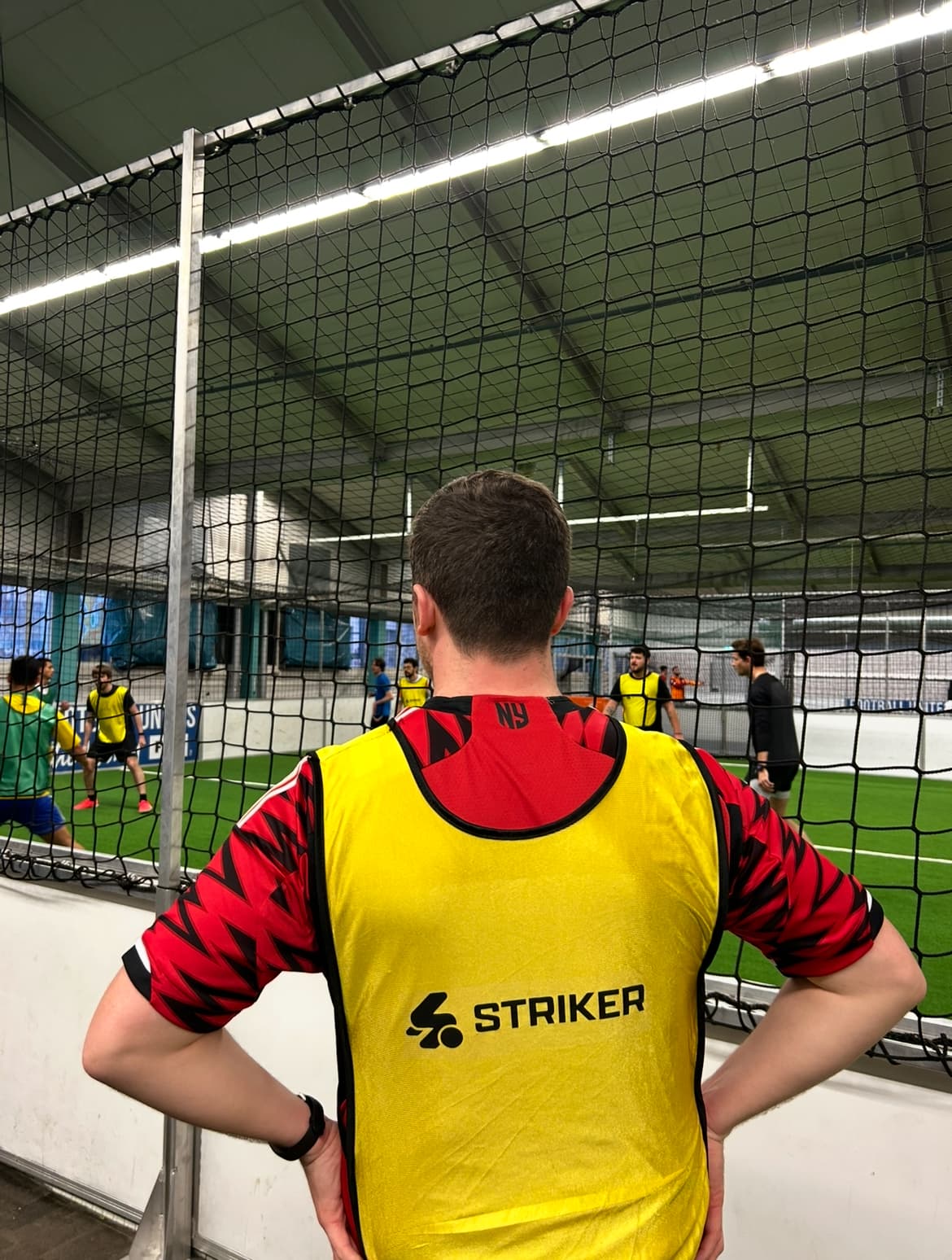
Pickup football in Zurich is simple: show up, play, and enjoy the game.
But new players often make a few small mistakes during their first game — mistakes that are completely understandable but easy to avoid once you know about them.
After organizing hundreds of matches and watching thousands of players go through their first experience with the Striker community, here are the five most common mistakes new players make — and exactly how to avoid them.
1. Wearing the Wrong Shoes
This is the single most common mistake, and it happens at almost every game that includes first-timers.
Most pickup football games in Zurich take place on artificial turf (3G or 4G rubber crumb pitches) or indoor hard-court surfaces. The correct footwear is:
- Turf shoes (TF) — small moulded rubber studs designed specifically for artificial grass. These grip the surface well without sinking in, and they're comfortable enough to wear for the commute from the office.
- Indoor football shoes (IC) — flat rubber outsoles, excellent on hard-court and indoor surfaces. If you play regularly, a pair of these is worth the investment.
What not to wear:
- Metal studs or long FG (firm ground) blades — these are designed for natural grass and are usually explicitly prohibited at artificial turf venues. Beyond being banned, they actually perform worse on turf and put you at risk of ankle injuries.
- Running shoes — they work in a pinch but have no lateral grip, which makes quick direction changes slippery and potentially dangerous.
- Casual sneakers — fine for park kicks, but the sole isn't designed for lateral movement, and they wear out fast on artificial turf.
Real scenario: At a Wednesday game at Josef Sportzentrum in Kreis 5, a new player showed up in Nike running shoes. He was fit and technically decent, but spent the entire game slipping on turns. In the third rotation, he twisted his ankle trying to cut — nothing serious, but he was done for the evening. The right turf shoes would have prevented it entirely.
The fix: Before your first game, check whether the venue is indoor or outdoor artificial turf. If outdoor turf, get TF shoes. If indoor or multi-sport court, IC shoes. You can find a decent pair at Athleticum, Ochsner Sport, or online for CHF 40–80.
2. Arriving Late
Pickup games rely on precise timing in a way that club football doesn't.
In a club setting, you can sneak in five minutes late during warm-up and nobody notices. In pickup football, late arrivals break the structure of the game format.
Here's why it matters: when 12 players show up for a 4v4v4 format, the organizer has built the team structure around that number. If you arrive 8 minutes into the session, you're now the 13th player. The organizer has to pause the game, restructure the teams, explain the new format to everyone, and restart. You've cost everyone 3–5 minutes of playing time.
The standard expectation in the Striker community is arriving 10 minutes before kickoff. This gives the organizer time to:
- Check you in and distribute bibs
- Form balanced teams based on skill level and experience
- Explain any specific rules for the format
- Start the match on time
Real scenario: At a Thursday 20:00 game near Escher-Wyss, three players arrived together at 20:12. The game had already started. The organizer had to halt play, redistribute bibs, and reorganize the teams. Two of the players who were already playing were noticeably frustrated — they'd arrived on time, warmed up, and were ready. The late arrivals themselves were apologetic, but the disruption was real.
The fix: Check the address the day before using the Striker app. Plan your commute with 5 minutes of buffer. If you know you're going to be late, message the organizer through the app in advance — most will accommodate if they know ahead of time.
3. Treating It Like a Club Match
This mistake takes two different forms, and both ruin the experience for everyone else.
Form 1: Excessive aggression. Pickup football is competitive but it's not a professional match. The goal is intense, skillful football in a safe environment. Reckless tackles, heavy shoulder barges, and aggressive challenges might be acceptable in a Sunday league match — they're not welcome here.
The pitches are small and the collisions happen fast. On a 4v4 cage pitch, a hard tackle in a confined space can cause serious injury. Experienced players and organizers notice immediately when someone crosses the line from competitive to aggressive, and they'll address it.
Form 2: Over-coaching and arguments. Some players who are used to a club environment arrive expecting to give tactical instructions, argue with calls, or referee other players' challenges. Pickup football is self-refereed, which means the culture relies on respect and mutual trust. Constant arguments shatter that trust.
Real scenario: At an evening game in Hürlimann Areal, a new player — clearly technically skilled — spent the first 15 minutes calling out teammates' positioning, arguing when the ball went out of play, and challenging other players' tackle decisions. By the second rotation, nobody wanted him on their team. After the session, two regulars told the organizer they would skip future games if he kept showing up. He wasn't invited back.
The fix: Come in with an open mind. Match the energy of the group. If you see something you disagree with, let it go the first time. If there's a real issue, speak to the organizer after the game. Football is the point — keep the focus there.
4. Underestimating the Intensity
This one catches a surprising number of people off guard — including players who think they're reasonably fit.
Small-sided football is significantly more demanding than a full 11-a-side game, minute for minute. In a standard match, a midfielder might touch the ball 40–60 times in 90 minutes. In a 4v4 game, you're touching the ball every 20–30 seconds and constantly in motion. There's no hiding behind a large team. Every player is directly involved in every phase.
Add to this the short distances involved. On a cage pitch, you're making 2–3 metre sprints, cutting, changing direction, and doing it again continuously. The cardiovascular demand is similar to an interval training session at the gym.
Real scenario: A marketing manager who played club football throughout secondary school joined a Wednesday game at Josef Sportzentrum. He hadn't played organized football in about six years but considered himself fit (he ran twice a week). By the 20-minute mark, he was genuinely struggling — breathing hard, making errors, and asking to rotate out more often than the format allowed. He sat out the last two rotations entirely.
The good news: after two or three games, your body adapts fast. Players who come back regularly report dramatically improved stamina within a month.
The fix: Don't plan a tough workout the same day as your first pickup game. Eat a light meal 90 minutes before. Bring a full water bottle. Accept that the first game will be harder than expected — and commit to coming back.
5. Not Talking to Other Players
Pickup football is social. This is not a side benefit — it's a core part of why the experience is worth showing up for week after week.
Many new players arrive, play quietly, leave immediately after the final rotation, and never quite integrate into the community. They miss the best part.
The social structure of pickup football is built into the format: you're constantly rotating between teams, playing with different people, and naturally crossing paths with everyone at the pitch. These are built-in conversation starters. Use them.
Before the game: Ask the organizer about the format, introduce yourself to the players nearest you while warming up.
During the game: Call for passes (even just a simple "yes!"), acknowledge good plays from both teams, keep communication light and positive.
After the game: This is where the real connections happen. Three to five minutes of post-game conversation is where friendships form. Ask players how long they've been coming. If someone played particularly well, say so.
Real scenario: Two players — one from Brazil, one from South Korea — both joined the same Wednesday game at Josef Sportzentrum in their first month in Zurich. They happened to be on opposite teams in the first rotation. After the game, they started talking about how they'd both arrived in the city recently and were looking for people to hang out with. They're now both regulars and have become part of a group that goes for post-game drinks once a month.
That's not an unusual story. It happens all the time in pickup football communities.
The fix: Commit to staying for at least 5 minutes after the final whistle. Introduce yourself to at least one person you haven't met before. It costs nothing and the upside is significant.
The Bigger Picture
These five mistakes — wrong shoes, arriving late, treating it like a club match, underestimating the intensity, and not socializing — are not signs of bad character. They're simply signs of inexperience with the pickup football format.
The format is different from club football in subtle but important ways. Once you understand the culture, the expectations, and the rhythms, it becomes second nature. Players who come back after their first game rarely make these mistakes again.
And the reward for getting it right is a genuine pickup football community: a weekly ritual that combines real exercise, competitive football, and a social network that extends well beyond the pitch.
A Quick Reference Before Your First Game
- ✅ Wear turf shoes (outdoor) or IC shoes (indoor)
- ✅ Arrive 10 minutes before kickoff
- ✅ Play competitive but respectful football
- ✅ Expect to be tired — it's harder than it looks
- ✅ Stay and chat after the game
Ready to Find Your First Game?
The Striker app lists all upcoming pickup football games in Zurich by date, venue, skill level, and available spots. You can reserve your place in under two minutes.
👉 Find your next game in Zurich 👉 Browse football fields in Zurich